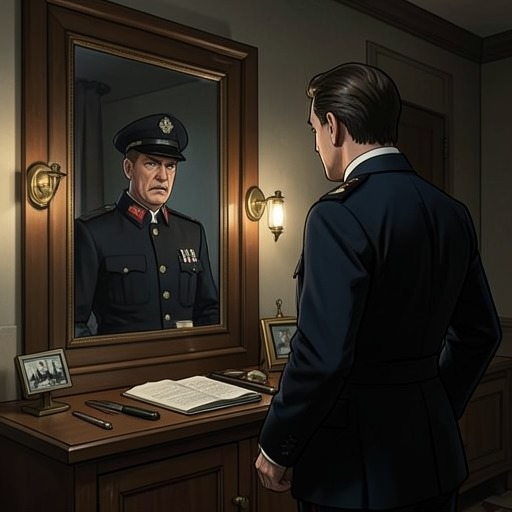
The night watchman smashes a mirror that isn’t there
Blind Willow, Sleeping WomanThe night watchman smashes a mirror that isn’t there is the climactic encounter in which a solitary worker at a school confronts what appears to be his own reflection—and recognizes it as a self that loathes him. In the morning, the mirror has vanished along with the supposed supernatural explanation: there was never one at all. The watchman’s final understanding is that the apparition was simply himself, making the episode an unsettling study of fear, divided identity, and the violence of trying to escape one’s own image.
The Night Walk
The encounter comes as the watchman is finishing his overnight rounds. After checking the school and finding nothing unusual, he heads back toward the janitor’s room, having first checked the boiler room beside the cafeteria on the building’s east side. The return route takes him along a long first-floor hallway. A typhoon is approaching; with no moon, the corridor is almost entirely dark, and intermittent breaks in the clouds only briefly alter the blackness. He walks faster than usual, his basketball shoes squeaking on the green linoleum, and grips the wooden kendo sword he carries.
Passing the school entrance midway along the hall, he glimpses something and turns, sweating, to shine his flashlight toward the wall beside the shoe-storage shelf. A full-length mirror stands there where, he believes, none stood the night before. He is relieved to find that the figure in it is his own reflection. Setting down the flashlight, he lights a cigarette; faint streetlight reaches the glass while the swimming-pool gate bangs in the wind behind him.
The Reflection Turns Hostile
After a few puffs, the watchman notices that the reflection is not simply an image of him. It looks exactly like him outwardly, yet feels like another self—one that should never have existed. What he can identify most clearly is its hatred: he experiences it as an immense, undiminishable loathing. The mirror does not reveal a separate ghost so much as make the familiar self suddenly strange and threatening.
The two figures stare at one another, apparently immobilized. The watchman’s cigarette slips from his fingers, and its reflected counterpart falls too. Then the other figure touches its chin and slowly moves its fingertips up its face. The watchman realizes that he is making the same gesture. For a moment, the ordinary relation between person and reflection seems to reverse: he feels less like the original than like the image of something in the glass, which is trying to take control of him.
The Blow and the Morning After
At last the watchman breaks free of his paralysis, roars, raises the wooden sword, and brings it down on the mirror. He hears glass shatter but does not look back. He races to his room, locks the door, and gets under the covers. Though he worries about the cigarette left on the floor, he cannot bring himself to return. The wind continues to howl, and the pool gate keeps banging until dawn.
The daylight overturns the apparent events of the night. After the typhoon passes, the watchman returns to the entrance and finds the discarded cigarette butt and wooden sword, but no mirror. He concludes that there never was one. The ordinary objects remain as evidence of what he did, while the central object that seemed to provoke his terror has no physical existence. The episode therefore leaves the watchman’s actions concrete and their apparent supernatural cause absent.
Fear and the Self
The watchman rejects the idea that he saw a ghost: what appeared in the glass was himself. His remembered terror crystallizes in the thought that the most frightening thing in the world is one’s own self. The encounter gives that idea a physical sequence: a familiar likeness becomes alien, its apparent hatred becomes impossible to endure, and the watchman answers by trying to destroy the image. But the morning’s revelation makes that violence inward-facing. There was no mirror to blame; the confrontation and the fear belong to the watchman’s relation to himself.
The event also extends beyond the single night. The watchman says that he has no mirrors in his house and that learning to shave without one was difficult. The missing mirror thus remains consequential even after the hallway encounter ends: he carries its lesson into an everyday refusal of reflective glass. The episode’s unsettling force rests on the gap between what he can verify—the cigarette, the sword, the remembered terror—and what disappears—the mirror that seemed to give his fear an external form.